
The project can be described as an exercise in cultural history, drawing upon a diverse array of sources, including historical, literary, and material ones. Building on the wide and diverse expertise of our team, we aim to investigate cross-cultural connections by putting side by side the evidence available for each of the regions covered.
As a multidisciplinary team, we explore how members of different European medieval societies crossed physical, social, linguistic, religious, and cultural frontiers and how they, in their turn, were affected by contacts with other social groups.
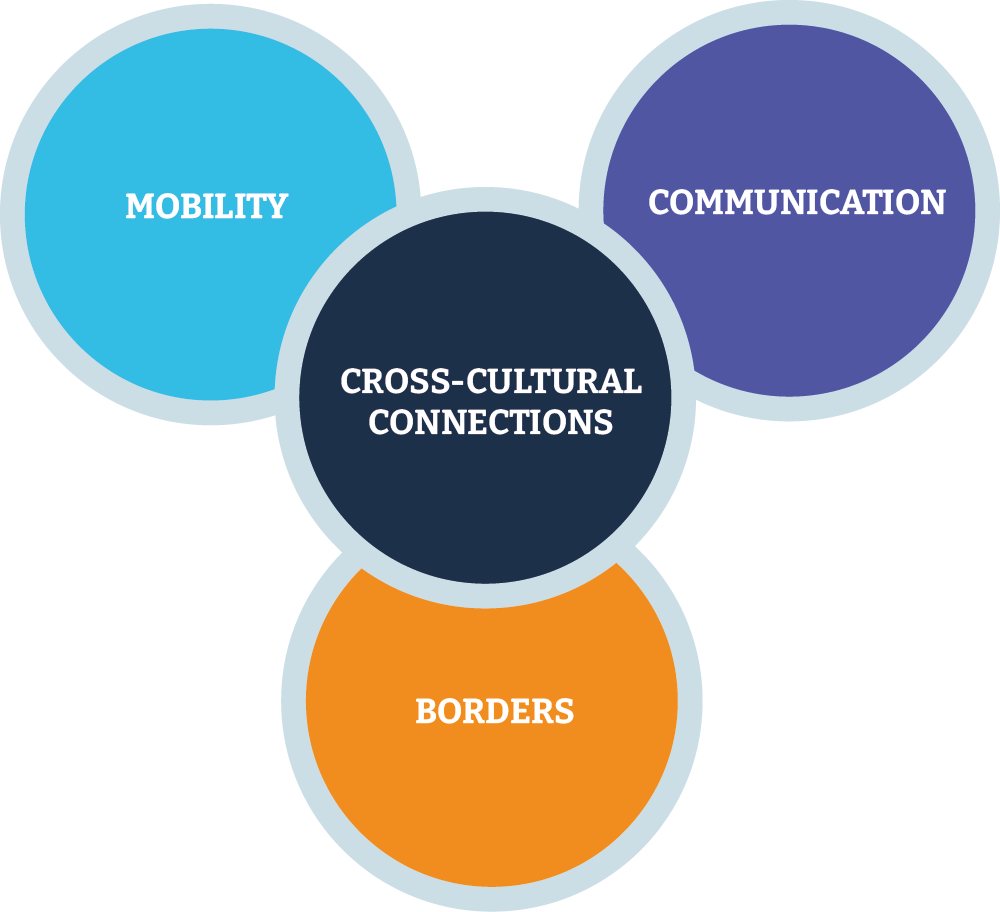
While in an earlier, related project we characterized these regions as ‘societies on the edges’ and explored how they perceived and described their marginality, we now aim to investigate efforts to overcome that marginality through long- distance travel, cross-cultural communication, and the molding and reshaping of borders and frontiers.
Research on past human mobility has attracted a great deal of scholarly attention in recent decades thanks to the so-called mobility turn, that is, the shift which has allowed for a new paradigm, focusing on mobile spatialization and relational space, to emerge in social sciences (URRY 2007). We intend to build on this turn by exploring different types of long-distance mobility from all the three regions covered by the project, including travel related to pilgrimage, diplomacy, military interventions, ecclesiastical business, trade, etc. We aim to combine research on the practicalities and insecurity of long distance travel in the early and central Middle Ages with investigations on the ways in which travellers from this period experienced foreign environments (REUTER 2006).
Medieval borders and frontiers have also garnered increased interest in recent years after a burgeoning of research on this topic during the 1990s (e.g. MANZANO 1991; BEREND 1999). These investigations have demonstrated that one should not think anachronistically of clear-cut lines, but, rather, of fluctuating borders, deep zones with diverse roles such as military defence and tax extraction, but also areas of cultural and ethnic mixing producing new identities and social realities (POHL 2005; BORRI 2024). Thanks to the wide-ranging expertise of our team, we can examine the effects of the shifting Andalusi frontier from the point of view of both Arabic and Latin sources. The latter allow one to appreciate how the southern expansion of the Christian realms from the late eleventh and twelfth centuries generated competition in the (re-)definition of diocesan borders, as well as institutional conflicts between episcopal and monastic powers (AGÚNDEZ SAN MIGUEL and GARCÍA IZQUIERDO 2023). The events of this period led to an increasing involvement of papal authority in Iberian affairs and to the pushing of former peripheral areas of al-Andalus towards integration within Western Christianity. This resulted in the development of documentary and record-keeping practices, such as the production of cartularies, which had already enjoyed a relatively long history in other areas of western Europe. We aim to study late eleventh- and twelfth-century origin of these practices in the Iberian Peninsula by exploring the role that writing and cartulary production played in redefinition of the above-mentioned bordering territories.
Past research in this area has encompassed a wide range of medieval communicative forms, including both written and oral ones (MOSTERT 2012). Within the geographical and chronological scope of this project we intend to draw on our multidisciplinary expertise, combining historical, linguistic, and literary approaches. The relations between Latin and vernaculars will continue to play a major role in our investigations, together with those between literacy and orality. Interlinguistic communication, that is interactions between people who were native speakers of different languages, will represent a significant area of research, especially with reference to Britain and the Germanic-speaking eastern Frankish territories, where the gap between written Latin and spoken vernaculars was much wider than in Romance-speaking areas. Comparable features, however, can also be observed in northern Iberia, and especially in documentary collections from Navarre and La Rioja, where names of Basque and Arabic origin make frequent incursion into the main Latin language of the documents (LOPETEGUI 2023). As John Gallagher and Purba Hossain have recently observed, language is still relatively marginal as a subject of historical analysis, despite it being so intimate to people’s lives (GALLAGHER and HOSSAIN 2023). In our interdisciplinary investigations we aim to actively counteract such a trend by examining the roles played by languages in facilitating cross-cultural connections and social cohesion, but also the difficulties that ignorance or limited knowledge of a given language could generate.
Select Bibliography
AGÚNDEZ SAN MIGUEL, L. and GARCÍA IZQUIERDO, I. (2023), ‘Introducción: La configuración del espacio diocesano: el territorio y sus agentes’, Espacio, Tiempo, Forma, Serie III. Historia Medieval, 36, pp. 17-20.
AGÚNDEZ SAN MIGUEL, L. and TINTI, F. (2024), ‘Introduction. New Perspectives after Thirty Years of Cartulary Studies’, Studia Historica. Historia Medieval, 42.1, pp. 3-8.
BEREND, N. (1999), ‘Medievalists and the notion of the frontier’, The Medieval History Journal, 2.1, pp. 55-72.
BORRI, F. (2024), ‘On empires and frontiers’, in Carolingian Frontiers: Italy and Beyond, ed. M. Betti, F. Borri and S. Gasparri, Firenze, Firenze University Press, pp. 9-36.
EGER, A. (2015), The Islamic-Byzantine Frontier. Interaction and Exchange Among Muslim and Christian Communities, London & New York: IB Tauris.
GALLAGHER, J. and HOSSAIN, P. (2023), ‘Languages of history, histories of language’, Past & Present, 261.1, available at https://doi.org/10.1093/pastj/gtad015
GARCÍA IZQUIERDO, I. and PETERSON, D. (2022), ‘Una memoria ficticia: toponimia y disputas diocesanas en la Divisio Wambae’, Edad Media: Revista de Historia, 23, pp. 209-33.
LARREA J. J. and LORENZO, J. (2012), ‘Barbarians of Dâr al-Islâm: the Upper March of al-Andalus and the Western Pyrenees in the eighth and ninth centuries’, in La Transgiordania nei secoli XII-XIII e le ‘frontiere’ del Mediterraneo medievale, ed. G. Vannini, M. Nucciotti, Oxford, BAR International Series, pp. 277–88.
LOPETEGUI, G. (2023), ‘La notación de onomástica no latina en diplomas del monasterio de Irache: usos fonográficos e influencia de la tradición gramatical’, Cuadernos de Filología Clásica. Estudios Latinos, 43.2, pp. 275-97.
MANZANO MORENO, E. (1991), La frontera de al-Andalus en época de los omeyas. Madrid, CSIC.
MOSTERT, M. (2012), A Bibliography of Works on Medieval Communication, Turnhout, Brepols.
PETERSON, D. (2019), ‘Order and disorder in the cartularies of San Millán de la Cogolla’, in From Charters to Codex: Studies on Cartularies and Archival Memory in the Middle Ages, ed. R. Furtado and M. Moscone, Turnhout, Brepols, pp. 119-34.
POHL, W. (2005), ‘Frontiers and ethnic identities: Some final considerations’, in Borders, Barriers and Ethnogenesis: Frontiers in late Antiquity and the Middle Ages, ed. F. Curta, Turnhout, Brepols, pp. 255-65.
POHL, W. (2024), ‘Frontier practices in the early Carolingian period’, in Carolingian Frontiers: Italy and Beyond, ed. M. Betti, F. Borri and S. Gasparri, Firenze, Firenze University Press, pp. 37-60.
REUTER, T. (2006), ‘The insecurity of travel in the early and high Middle Ages: Criminals, victims and their medieval and modern observers’, in Medieval Polities and Modern Mentalities, ed. J. L. Nelson, Cambridge, Cambridge University Press, pp. 38-71.
TINTI, F. (2021) ‘Latin and Germanic vernaculars in early medieval documentary cultures: towards a multidisciplinary comparative approach’, in The Languages of Early Medieval Charters: Latin, Germanic Vernaculars and the Written Word, ed. R. Gallagher, E. Roberts and F. Tinti, Leiden, Brill, pp. 1-21.